
What Happens After an ABA Referral? A Parent’s Guide to Getting Started

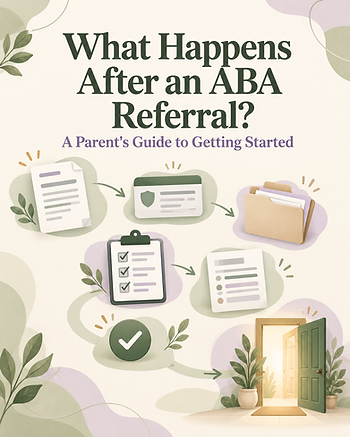
Receiving a referral for Applied Behavior Analysis, commonly called ABA therapy, can bring a mixture of relief and uncertainty.
You may feel relieved that someone has recommended support for your child. At the same time, you may be wondering what the referral means, who you should contact, what paperwork you will need, and how long it will take before services begin.
The first thing to understand is that a referral is usually the beginning of the process. It does not automatically enroll your child in therapy or determine what their treatment will look like.
Requirements can vary depending on your child’s needs, insurance plan, location, and chosen provider. However, most families can expect several common steps.
Step 1: Contact an ABA Provider
After receiving a referral, the next step is usually contacting an ABA provider.
During the first conversation, the provider may ask for basic information about your child, including:
Your child’s age
The reason ABA was recommended
Any diagnosis your child has received
The referring professional’s information
Your insurance coverage
The skills or concerns your family would like help addressing
Where services may be needed
You do not need to understand every part of ABA before making this call. The provider should be able to explain its intake process, the areas it serves, the insurance plans it accepts, and the documents it needs from you.
This is also a good time to ask whether the provider currently has availability.
Step 2: Verify Insurance Coverage
ABA coverage and authorization requirements vary by insurance plan.
The provider may request a copy of your insurance card and other identifying information so its staff can verify your benefits. Verification can help determine whether ABA is covered, whether a referral or diagnosis is required, and whether your plan requires prior authorization.
Families should also contact their insurance company directly. Ask whether ABA services are covered, which providers are in network, whether you have a deductible or copayment, and what documentation is required.
For children covered by Florida Medicaid, behavior analysis services must meet medical necessity and eligibility requirements. Florida Medicaid also requires authorization before covered behavior analysis services begin.
Insurance approval and clinical recommendations are separate issues. A provider may recommend services based on an assessment, but the insurance plan still determines what it will authorize under its coverage rules.
Step 3: Gather the Required Documents
The provider will tell you which records are needed. Depending on the insurer and your child’s situation, documents may include:
The ABA referral
Diagnostic records
Medical or developmental evaluations
Previous treatment plans
School reports or an Individualized Education Program
Insurance information
Relevant medical history
Contact information for other professionals involved in your child’s care
Do not panic if you do not have everything organized. Ask the provider for a written checklist and work through it one document at a time.
If something is missing, ask whether the provider can help you identify where to request it.
Step 4: Complete the Intake Process
The intake process helps the provider learn about your child and family before completing a formal assessment.
Parents and caregivers may be asked about:
Communication
Daily routines
Independence
Social interaction
Safety concerns
Strengths and interests
Situations that are difficult
Previous services
Family priorities
Be honest about both the hard moments and the things your child does well. A useful treatment plan should reflect the whole child, not only the concerns that led to the referral.
You should also have room to share what matters most to your family. The Behavior Analyst Certification Board states that behavior analysts should involve clients and relevant caregivers in selecting goals, designing assessments, developing interventions, and monitoring progress.
Step 5: Participate in an ABA Assessment
Before treatment goals are finalized, a qualified behavior analyst will usually complete an assessment.
The assessment may include:
Interviews with parents or caregivers
Review of medical, developmental, and educational records
Direct observation
Standardized assessment tools
Information about current skills
Discussion of family priorities
Identification of areas where support may be helpful
An assessment should not be used to create the same plan for every child. It should help the clinical team understand the individual child’s needs, environment, strengths, preferences, and available support.
The BACB Ethics Code states that assessments and interventions should be based on scientific evidence and selected according to the client’s needs, circumstances, and resources. It also requires behavior analysts to explain assessment procedures and results and obtain informed consent when required.
Florida Medicaid specifically requires an assessment before behavior analysis interventions begin. Its coverage policy also requires treatment goals to be observable and measurable and to include procedures for monitoring and reporting progress.
Step 6: Review the Proposed Treatment Plan
After the assessment, the behavior analyst may recommend a treatment plan.
The plan should explain:
The skills being addressed
Why each goal was selected
How the skills will be taught
How progress will be measured
Where services may take place
The recommended schedule or level of service
How caregivers may participate
How goals will be reviewed and changed
Goals should connect to meaningful parts of daily life. Depending on the child, this could include asking for help, expressing preferences, communicating discomfort, completing parts of a routine, developing safety skills, or becoming more independent with everyday activities.
The goal should not be to make every child appear or behave the same. Current federal guidance emphasizes that ABA services should be individualized, clinically appropriate, evidence based, and delivered according to each child’s needs rather than through a standard service model.
Parents should ask questions before agreeing to the plan.
You might ask:
Why was this goal chosen?
How does this goal help my child in everyday life?
How will progress be measured?
How will my child’s preferences be considered?
What happens if an approach is not helping?
How will I receive updates?
How can we support these skills at home?
How will my child be involved in decisions when appropriate?
You deserve clear answers. You should not be expected to sign a treatment plan you do not understand.
Step 7: Wait for Authorization When Required
If insurance authorization is required, the provider will submit the assessment, proposed treatment plan, and supporting documentation to the insurance company or managed care plan.
The insurer may approve the request, request more information, authorize a different amount of service, or deny part or all of the request.
This step can take time even when the ABA provider has an immediate opening.
For Florida Medicaid, authorization is required before behavior analysis services begin, with continued authorization required periodically.
Ask the provider how it communicates authorization updates and whom you should contact if the insurer requests additional information.
Step 8: Begin Services and Review Progress
Once the required approvals are received and scheduling is completed, services can begin.
The first few sessions may focus on helping your child become familiar with the provider, learning about preferences, and building a comfortable working relationship.
ABA treatment should not remain fixed when something is not working. The clinical team should collect information, review progress, communicate with the family, and adjust goals or teaching approaches when needed.
Florida Medicaid requires ongoing progress reporting and updated treatment information when continued services are requested. Its policy also recognizes caregiver participation and training as parts of covered behavior analysis services when clinically appropriate.
Families should receive understandable updates. Data should help explain what is happening, not make parents feel shut out of the process.
Do I Have to Join a Waitlist?
Not necessarily.
Some ABA providers have long waitlists, while others have current availability. Availability can also depend on location, insurance participation, staffing, the recommended schedule, and the setting where services will be delivered.
Amy’s Angels Health Care currently has no waitlist for ABA therapy.
This means families can contact the office now to discuss availability, accepted insurance plans, required documentation, and the steps needed to begin the intake process.
However, no waitlist does not mean every child can begin therapy immediately. Insurance verification, clinical assessment, authorization, scheduling, and other requirements may still need to be completed first.
Being transparent about this distinction helps families understand what “no waitlist” actually means.
Questions to Ask Before Choosing an ABA Provider
A referral does not prevent you from asking questions or learning more about a provider.
Consider asking:
Who will complete my child’s assessment?
Who will supervise treatment?
How are goals selected?
How are parents and caregivers involved?
How will my child’s assent and preferences be respected?
How often will we receive progress updates?
How will concerns or disagreements be handled?
How does the team coordinate with other professionals?
What insurance and authorization steps are required?
What happens when a goal is reached or no longer appropriate?
The right provider should be willing to explain its process clearly.
You Do Not Have to Understand Everything Before Calling
Getting started with ABA therapy can feel like a lot of information at once.
You do not need to understand every insurance term, assessment, credential, or treatment code before making the first call. A responsible provider should help you understand what is needed and what happens next.
At Amy’s Angels Health Care, we provide individualized ABA therapy for families throughout South Florida. Our team can help you learn about current availability, insurance coverage, required documentation, and the intake process.
Amy’s Angels Health Care currently has no waitlist for ABA therapy.
If your child has received an ABA referral, contact our team to learn how to begin.


Comments